
AI is the topic on everyone’s minds these days. It has fundamentally changed the way people think about work, life, the future, you name it.
Use of AI has been one of the most common topic threads in all the events, conferences, webinars, etc. that we’ve attended for the last year. Specific to our industry, people want to know how to start leveraging it, but they also want to know how to do that in a way that is responsible and mission-aligned.
What follows is our take on an AI usage philosophy that we think aligns well with the mission space we all exist in. Taking the best that AI has to offer while ensuring we use it to build on the human connections and judgment you’ve already built in your organization.
Why does AI demand a philosophy at all?
No other recent technology has created this much noise in the working world. Code automation, digital transformation, these things didn’t often have an accompanying ethical discussion attached to them.
These innovations were largely seen as obvious net benefits to the way an organization ran. People were slow to adopt these technologies purely out of inertia, not conscientious objections.
AI has been different, it raises questions about the ethics of this level of technical automation, the impact it will have on human jobs, and the environmental impact of its use. In our space of mission-oriented work, these ethical concerns carry more weight than in traditional for-profit corporations.
Failure to use AI properly carries outsize brand and trust risk with the clients of mission-driven organizations vs their for-profit counterparts and that’s worth paying attention to.
How does Moonwake think about responsible AI use?
We use the same philosophy internally and with our clients. The most succinct way to put it is this:
We use AI where it demonstrably and uniquely serves the mission, and nowhere else.
There are two key parts of this statement:
“Demonstrably” means that the AI-powered solution to a given problem has to significantly outperform alternative solutions in its ability to solve the problem.
“Uniquely” means that the use of AI is the key part that unlocks the problem. AI can’t just be the easier path, it needs to be uniquely capable of doing this work vs more traditional code automation or a human-led workflow.
Once we’ve decided to use AI to address a problem or opportunity, we have 6 pillars we adhere to when designing the actual solution itself.
Moonwake’s 6 Pillars for AI Solution Design
1. AI is a tool, not the strategy
AI, like any other technology, has no value on its own. The value you can derive from AI only comes when you apply it to a worthwhile job to be done.
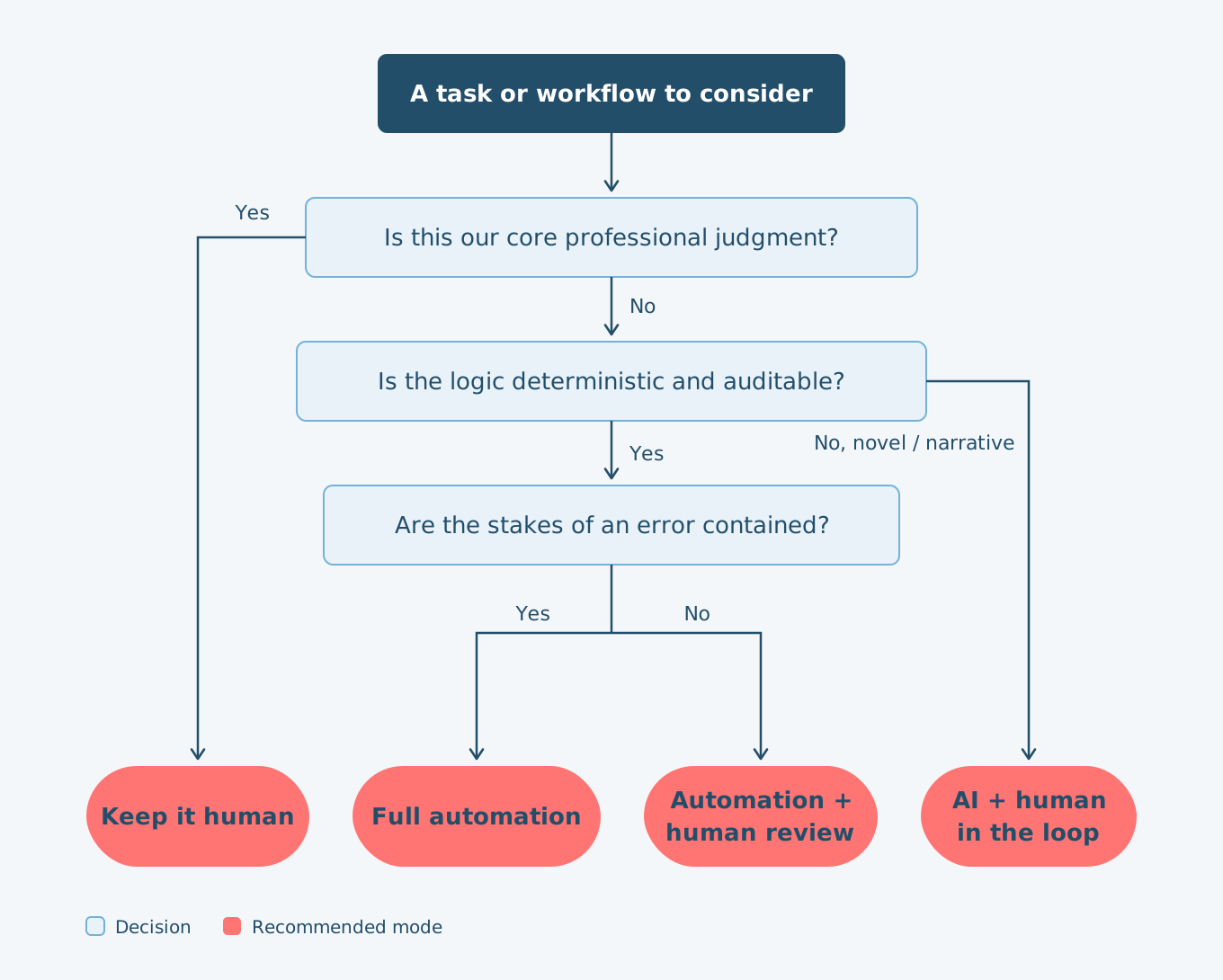
We don’t go out looking for “things we can do with AI” and try to fit AI into a problem we think it’d be good at. We start with the problem or opportunity we’re trying to unlock and if AI is a good fit, then we’ll bring it to bear. A simple flowchart guides our choice of tool.
2. Use AI’s capabilities in proportion to your needs
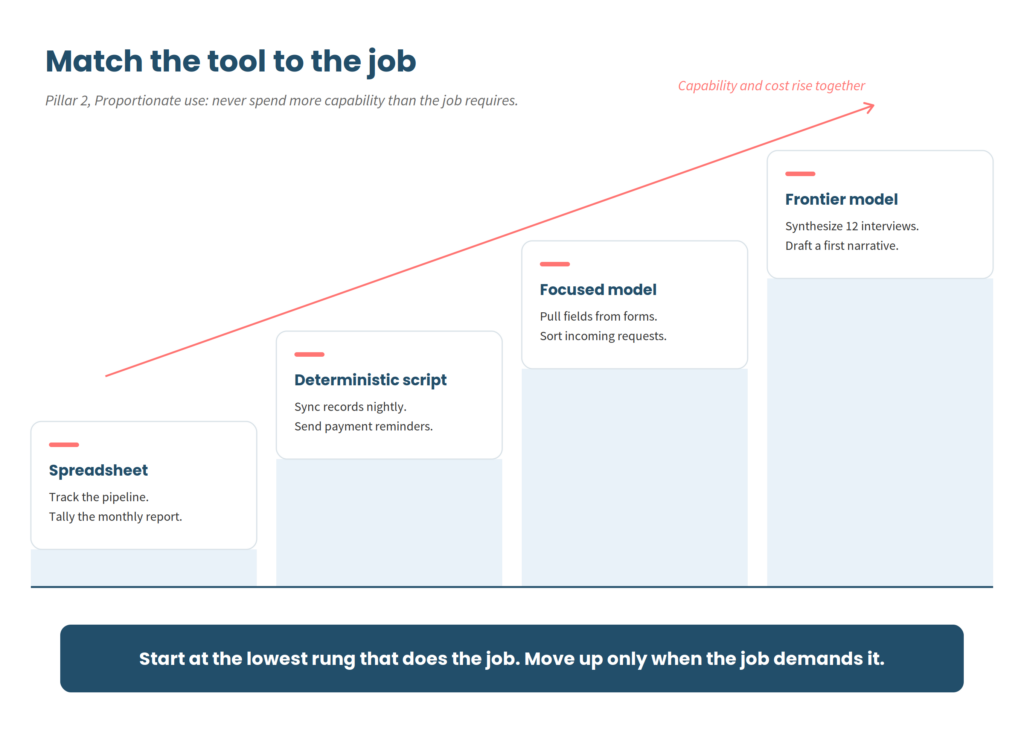
Within the bucket of capabilities we call AI, there are a number of different flavors you can use for any given task.
The simplest example of this is the different models you can choose from when using something like Claude or ChatGPT.
We always design systems to use the lowest cost model that has the necessary capability to do the work. We don’t recommend using the most powerful flagship models at roughly 5x the cost per run when a standard capability model will work. We use tools like OpenRouter to help right-size model selection for the use case.
Knowing these differences will not only add up in terms of your own savings as an organization, but also helps to limit the impact of your organization’s AI use on the environmental resources needed to power these tools.
3. Humans always make the decisions
We see AI being most valuable in our space when it helps the human make better, more informed, or faster decisions.
AI is demonstrably and uniquely faster at this exact kind of work. Gathering data, summarizing large amounts of information for easier human consumption, and flagging potential issues quickly are all things AI is uniquely qualified to do.
The line we don’t cross is handing the decision over to an AI tool in lieu of a human. We believe this is where boundaries of responsible and ethical use get crossed.
4. Data privacy is non-negotiable
It is imperative that every organization starting to use AI-powered tools understands how that provider treats the data they give it. Each provider has a different licensing floor you have to pass before you can guarantee your data is not used for model training purposes or that support personnel aren’t able to see PII during their course of work.
We recognize that for AI to be able to perform the jobs we need it to, there will have to be PII / CII given to the tools for analysis or summarization. That means that we are adamant that tools are licensed appropriately so organizational data is handled safely and securely.
Additionally, these tools are always in flux so we use control tools like OpenRouter to help enforce our privacy policies across tool providers and models. This ensures a private, secure footprint for everything we build.
5. AI should be used to widen access to services, not narrow it
The mission-driven space that we all live in exists because the mainstream systems of society have excluded the very people we exist to serve.
We cannot let the use of AI tools recreate that problem within our own organizations.
Whenever we have a solution being designed that leverages AI, we work to keep bias out of the design, and we seek out and correct unintentional bias on an ongoing basis.
6. AI will change people’s jobs, we owe them honesty about what that means
We believe that AI should always and only be used to improve the human-held jobs in your organization. In order for that to happen, AI will reshape what that person’s job is now.
We believe that people affected by the introduction of AI should have a hand in deciding how that reshaping looks and we strive to include affected employees in that design process.
When done right, AI can be used to help your people do more of the job they love and take the tedious work off their plates. It can be a net-benefit for your people, as long as it is designed with their job satisfaction as a consideration.
How does Moonwake hold ourselves to this philosophy?
These principles define how we work, this is not simply nice marketing. We hold ourselves to these pillars daily, here are some example practices we employ to help do this:
- We recommend against AI when simpler automation is the better choice, and we take the time to explain why so our clients understand and agree with the rationale.
- We put human review gates into every AI workflow we design.
- We use the decision flowchart above against our own tools and operations as we evolve. This is a working tool for us.
Our own philosophy is maturing and evolving over time. As it does, these articles will also mature and evolve so we’re always sharing our thinking with the space.
Six questions to help you pressure test your own work
Here are six simple questions you can ask yourself whenever a new AI initiative is proposed to help guide your thinking about how to move forward.
- What job is this doing, and could something simpler do it?
- Does the capability match the task, and do we know the resource cost per run?
- Who is reviewing the output of this tool, who is making the final call in the workflow?
- Where does our data go, and can the vendor prove their privacy claims?
- Does this approach widen or narrow access for the groups we serve?
- Which roles will change, how are we bringing them along to help design this solution?